Subscribe for Free!
Join our newsletter to explore innovative sustainability initiatives, eco-friendly tips, and impactful activities
Join our newsletter to explore innovative sustainability initiatives, eco-friendly tips, and impactful activities
Your Startup Doesn't Need Funding First. It Needs Protection.
September 2, 2026
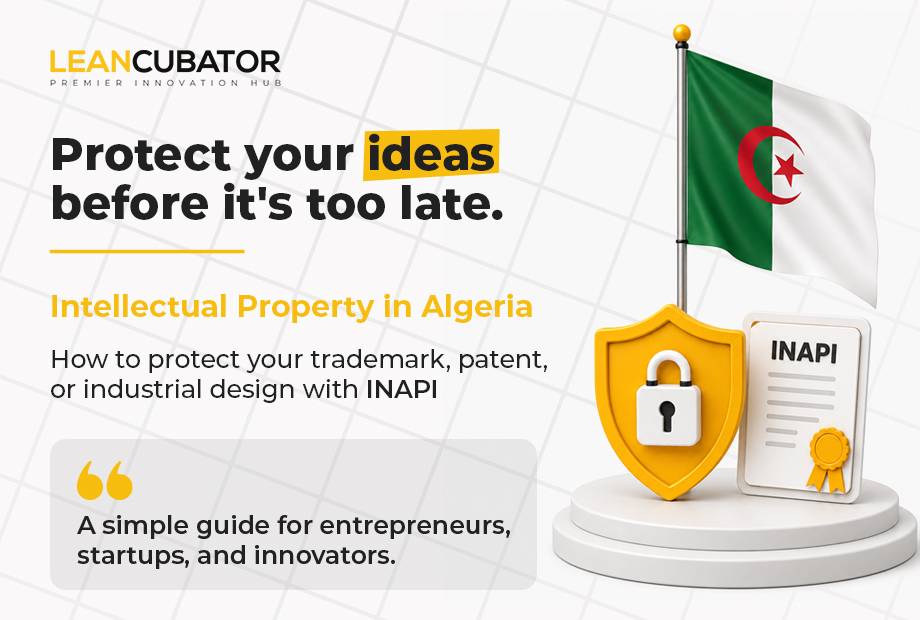
This is one of the biggest mistakes made by project holders in Algeria.
Many entrepreneurs spend months developing a product, creating a brand, designing a logo, or building a new technology. Then they present it during competitions, pitch it to investors, post it on social media, or even discuss it with potential partners...
...without ever thinking about intellectual property.
The problem isn't that someone will necessarily steal your idea.
The real risk is losing control over the assets that make your business unique.
An idea alone has little value. Executionand ownershipcreate value.
There is a common belief among entrepreneurs that "ideas are everything."
In reality, investors rarely invest because someone has an idea.
They invest because someone has built something that can be protected, commercialized, and scaled.
Imagine two startups that developed the same innovative solution.
The first one has:
a registered trademark;
a protected industrial design;
ownership of its technology;
clear documentation proving who created what.
The second startup has none of these.
Which one would you trust with your investment?
Protecting intellectual property is not just a legal formality it is a business strategy.
In Algeria, intellectual property is still underused.
Every year, hundreds of innovative projects participate in hackathons, startup competitions, university challenges, incubation programs, and acceleration initiatives.
Many teams spend months perfecting their business model.
Very few spend one day asking:
"How do we legally protect what we've created?"
This often happens because entrepreneurs believe intellectual property is only useful for large companies or multinational corporations.
In reality, startups are the ones who need it the most.
Unlike established companies, startups usually have very few tangible assets.
Their greatest value often lies in:
their brand;
their technology;
their product design;
their software;
their innovation.
These are exactly the assets that intellectual property is designed to protect.
Before looking for investors, ask yourself these five questions.
Can someone else register the name I'm using?
Does my logo legally belong to my company?
If tomorrow my product succeeds, what exactly prevents competitors from copying it?
If I bring in a new partner, who owns the technology?
If an investor performs due diligence, what intellectual assets can I actually demonstrate?
If these questions are difficult to answer, it's probably time to think about intellectual property.
Protection starts much earlier than most entrepreneurs think.
Many founders wait until they launch their product to think about protection.
Often, that's already too late.
The best time to consider protecting your innovation is while you're still building it.
This doesn't necessarily mean filing every possible registration immediately.
It means making intellectual property part of your startup strategy from day one.
Keep records of your development process.
Clearly define ownership among co-founders.
Choose a distinctive brand before investing in marketing.
Avoid publicly disclosing technical innovations before understanding whether they may qualify for patent protection.
These simple habits can save months of legal and commercial difficulties later.
Intellectual property is also a competitive advantage.
Investors don't only evaluate your product.
They evaluate whether your business can defend its market position.
Partners want to know who owns the technology.
Customers trust brands they recognize.
International expansion often begins with a protected brand.
In other words, intellectual property is not just about preventing copying.
It is about creating value.
Building an innovation ecosystem means building a protection culture.
Algeria's startup ecosystem has made significant progress over the past few years.
More startups are being created.
More incubation programs are emerging.
More founders are thinking globally.
The next step is developing a stronger culture of intellectual property.
Innovation deserves protection.
Not because every idea will become the next unicorn... but because every entrepreneur deserves the opportunity to grow with confidence, knowing that the value they create belongs to them.

Accredited by the National Committee for the Incubator Label in Algeria.