Beyond Innovation: Strengthening Agritech Startup Finance in Algeria with GIZ
March 31, 2026
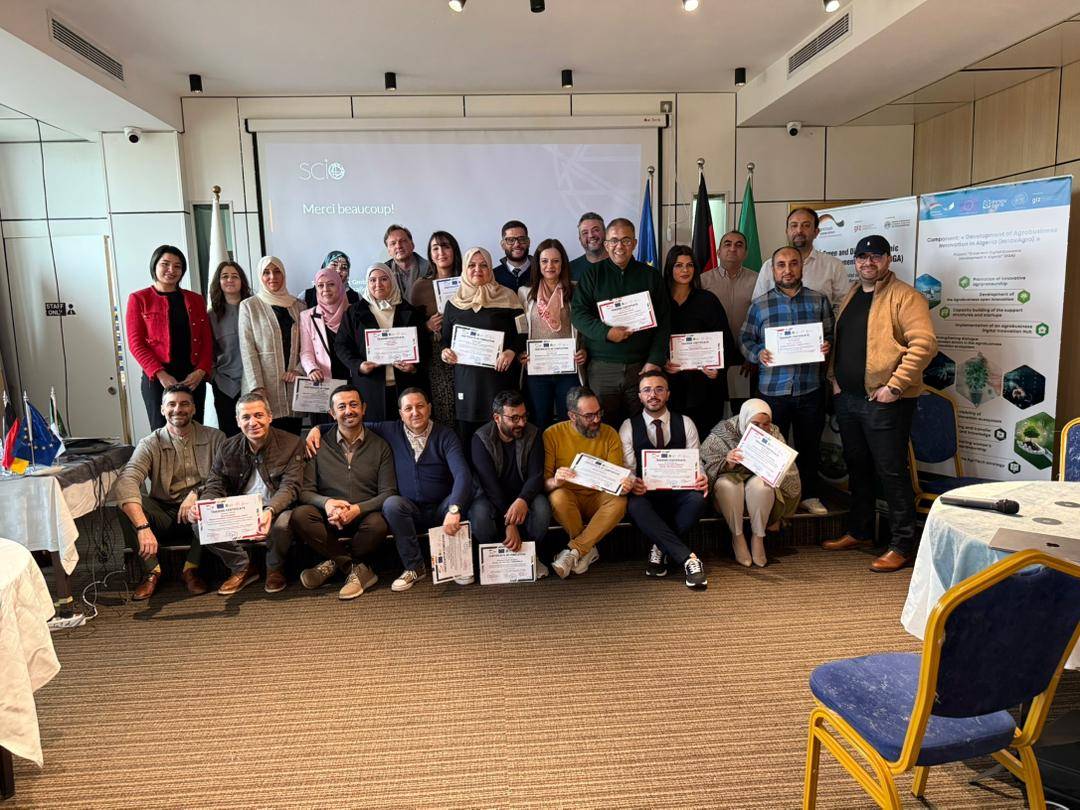
The sixth and final session of the InnovAgro capacity-building program was held in Algiers, Algeria, at Hotel Bay Diab, from 29 to 31 March 2026. The session brought together incubators, accelerators, and ecosystem actors working on agritech innovation in Algeria, focusing on one of the most critical challenges for startups in the sector: access to finance.
Implemented under the DGA program (Digital and Green Entrepreneurship Development in Algeria) and supported by the international cooperation framework led by GIZ and the European Union, the training aimed to strengthen the capacities of support structures in guiding agritech startups through financing pathways.
The session concluded a broader learning journey that included previous modules on Agritech fundamentals, Artificial Intelligence, Prototyping and FabLabs, Go-To-Market strategies, and IoT & Robotics in agriculture. The final module focused specifically on building a strong understanding of financing ecosystems and investment readiness.
Leancubator was represented in this final session by its Project Coordinator, Salem Hydaia, who actively participated throughout the three days in Algiers, engaging in discussions, exercises, and ecosystem exchanges around strengthening agritech incubation and improving access to finance pathways for startups.
Over the three days, the workshop shifted the focus from technological innovation to financial sustainability, a transition that many participants described as essential but often overlooked in early-stage ecosystem development.
The first day opened with a direct exploration of the realities of financing agritech startups. Discussions quickly highlighted the structural challenges: long validation cycles, capital-intensive solutions, research and development costs, and the persistent gap between innovation timelines and investor expectations.
Speakers from different parts of the ecosystem, including public financing structures, SME support institutions, and private investors contributed to a layered understanding of the funding landscape. While financing instruments do exist, participants emphasized that access remains complex, fragmented, and difficult to navigate for early-stage startups.
A key reflection emerged during the day: many agritech startups are not failing because of weak ideas, but because their value proposition is not yet translated into a language that investors and financial actors can clearly interpret.
The second day moved into a more applied and practical dimension. Through pitch reviews, group exercises, and real case analyses, participants worked directly on investment readiness in practice rather than theory.
The Financing Strategy Lab became one of the central activities of the day, where different startup profiles were analyzed and tailored financing pathways were designed. The exercise reinforced an important lesson: there is no universal funding model for agritech startups each case requires a specific combination of tools, timing, and strategic positioning.
Further discussions explored the growing interest in crowdfunding mechanisms in Algeria, highlighting both opportunities for alternative financing and the structural limitations that still need to be addressed for wider adoption.
The day was also enriched by exposure visits, including participation in the CTO Forum ecosystem activities, offering participants a broader view of how innovation ecosystems are evolving beyond training spaces into real implementation environments.
The third day shifted the perspective once again this time focusing on the role of incubators themselves within the access to finance ecosystem.
Rather than asking how startups get funded, the central question became: how can incubators actively enable and structure access to finance for their startups?
International venture capital perspectives added a global dimension to the discussion, emphasizing that connecting local startups to international funding requires more than readiness it requires strategic positioning, structured pipelines, and long-term ecosystem alignment.
Much of the day was dedicated to practical tools and internal systems that incubators can adopt, including structured evaluation checklists, investment readiness frameworks, and support processes designed to improve the quality of startup financing journeys.
By the end of the session, the focus had clearly shifted from understanding the ecosystem to taking responsibility within it particularly for incubators acting as intermediaries between startups and finance.
Following the official closing, a coaching phase was launched with selected incubators. This phase focused on operational implementation, including matchmaking with coaches, selection of support tracks, and co-creation of practical frameworks to strengthen access to finance support systems within incubation structures.
What emerged from this final session was not just a consolidation of knowledge, but a shift in perspective: agritech innovation is not only driven by ideas or technology, but by the financial and institutional systems that allow those ideas to survive, scale, and create long-term impact.